
Insurance: A Front-Line Conversation In Real Estate

It wasn’t very long ago that homeowners insurance lived quietly in the background of a real estate transaction. It was assumed coverage would be available, reasonably priced, and relatively easy to secure. Buyers sometimes waited until the final days of escrow to secure a policy, confident it was little more than a procedural box to check before closing.
Today, that reality has shifted dramatically. In the wake of catastrophic events, from the Lahaina fire to the more recent Palisades and broader Los Angeles fires, insurance has moved from an afterthought to a front-line real estate conversation. It now surfaces early in escrow, and increasingly, in the day-to-day lives of homeowners.
It’s no longer unusual to hear friends or neighbors share that they’ve been non-renewed, even without filing recent claims. At the same time, premiums have risen sharply, transforming insurance from a rounding error in the household budget into a meaningful line item that owners actively plan for.
To better understand the forces shaping this shift, I sat down with local insurance broker Rich Sabatowski, owner of Beach Break Insurance, to discuss market conditions, how coastal communities like Coronado are being affected, and where he sees the landscape heading.
According to Sabatowski, the most significant change over the past 12–24 months isn’t just coverage eligibility, it’s homeowner behavior.
Filing smaller damage claims, once common, is now given much more thorough consideration. Higher deductibles, stricter underwriting, and the prevailing threat of non-renewal have forced homeowners to think more strategically about when to involve insurance at all. His general rule: a claim should be at least twice the deductible before filing.
It’s a far cry from prior decades, when many condo policies carried minimal deductibles and annual premiums measured in the hundreds. That market, he notes, isn’t coming back.
Before the recent wildfire events, water damage was the leading cause of loss. Today, mitigating water exposure is one of the most important things a homeowner can do, especially in Coronado where threat of wildfire is low. Even a single water claim can severely impact insurability, and is somewhat akin to how getting a DUI can impact auto insurance because of the long-term consequences attached.
While wildfire dominates headlines, Sabatowski points out that in coastal markets like Coronado, the larger issue is replacement cost, the resulting premium increases, and having full coverage because of these increases.
Construction inflation has fundamentally changed how insurers calculate rebuild coverage. Pre-pandemic, insuring a home at roughly $400 per square foot in Coronado may have been adequate. Today, that figure has in many cases doubled.
The downstream effect is significant. What once might have been a $40,000 claim could now reach $150,000, particularly when high-end finishes or custom work are involved. For homeowners, underinsuring replacement cost has become one of the greatest financial exposures. Premium increases naturally follow, Sabatowski explains. Large-loss fire events exposed how underinsured many properties were on replacement cost.
Still, homeowners aren’t powerless. Preventative maintenance, especially plumbing, can materially reduce risk. Annual supply-line inspections and automatic water shut-off systems that actively stop leaks, are becoming increasingly popular. This is particularly important for second homes that may sit vacant for extended periods. Carriers are also scrutinizing property infrastructure more closely than ever.
Electrical panels such as Zinsco and Federal Pacific, common in homes built in the 1970s, are frequently considered uninsurable. Knob-and-tube wiring, still present in some older Coronado homes, also remains one of the most difficult challenges when securing coverage. Beyond electrical, carriers want to see updates within the past 30 years across other mechanical and structural systems, such as roofing and seismic retrofits.
Full gut renovations aren’t required, but aging systems do create more scrutiny by the insurance company. Beyond financial cost, severe claims often displace families for months, a disruption many owners underestimate. This is another reason why preventative maintenance is so important.
In Coronado and beyond, higher-value homes introduce additional complexity. Once replacement costs exceed roughly $3 million, carrier options narrow considerably. Importantly, insurance is based on rebuilding the structure, not market value, which is a distinction many homeowners misunderstand. Short-term rentals add another underwriting layer. While coverage remains available, carrier options shrink dramatically.
Despite recent turbulence, Sabatowski sees signs of stabilization. “We are past the peak pain point,” says Sabatowski. As carriers re-enter the market and California state regulatory adjustments take hold, premiums should level off, if not decline.
His most consistent advice is simple: understand your coverage before you need it. Because while insurance may feel like just another bill, it becomes one homeowners are profoundly grateful to have if a loss occurs.
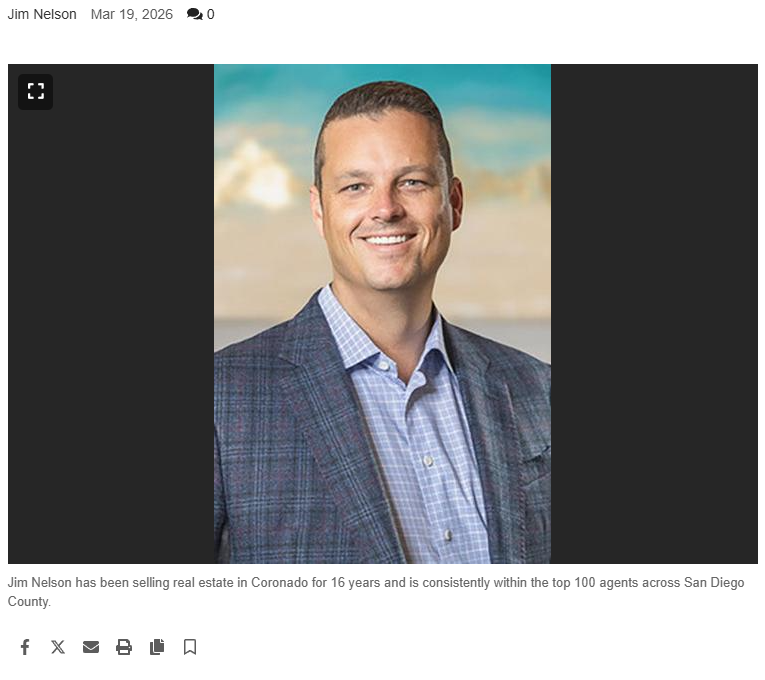
Jim Nelson has been selling real estate in Coronado for 16 years and is consistently ranked within the top 100 agents across San Diego County. Rich Sabatowski is an insurance broker and owner of Beach Break Insurance. He can be contacted at rich@beachbreakinsurance.com for direct inquiries.
VOL. 116, NO. 11 - Mar. 18, 2026
Categories
Recent Posts




GET MORE INFORMATION
